
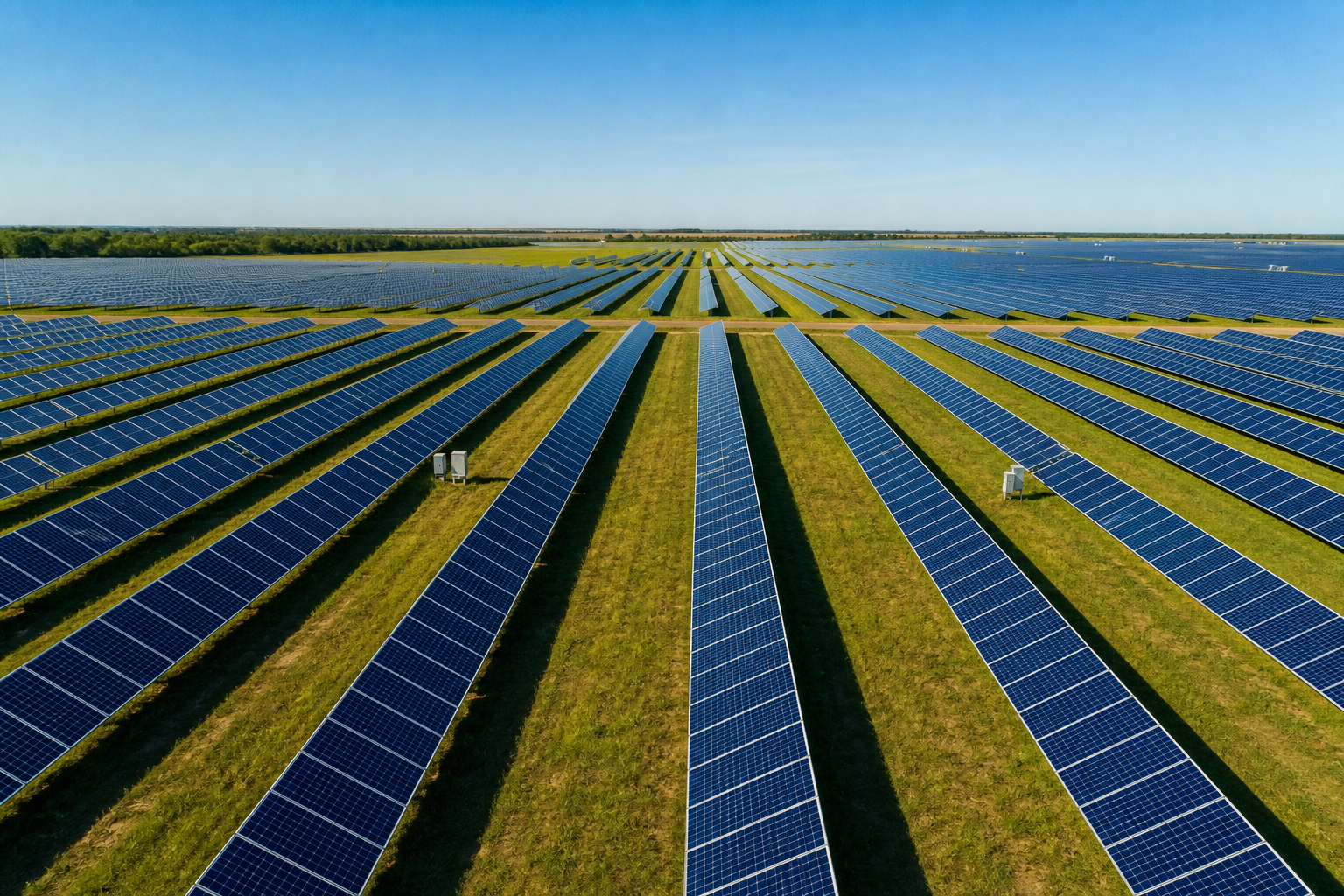
Kern County is one of the hardest places in America to keep a solar array clean, because three soiling sources stack on top of each other: agricultural dust off the southern San Joaquin Valley, oilfield and road dust from the Bakersfield basin, and wind-driven desert grit coming over the Tehachapi gap from the Mojave. Most counties deal with one of those. Kern deals with all three, through a dry season that runs most of the year. Every Detail Solar cleans and mows commercial and utility-scale arrays across the county, from Bakersfield rooftops to the ground-mount and tracker farms out toward Mojave and Rosamond.
Why Kern County arrays soil faster than almost anywhere else
Kern County sits at the bottom of the San Joaquin Valley, which is effectively a bowl. Air sits in it. The same inversion that gives the valley its air-quality reputation also means airborne particulate does not clear, it settles, and a large share of it settles on glass.
Three distinct contributors:
- Agricultural operations. Kern is one of the highest-value agricultural counties in the country. Tillage, harvest, almond and pistachio operations, and bare-soil periods between crops all put fine particulate into the air on a seasonal cycle. Orchard dust in particular is fine enough to bond rather than blow off.
- Oilfield and unpaved road traffic. The Bakersfield basin has active extraction and a dense network of service roads. Vehicle-generated dust from unpaved and semi-paved surfaces is coarse, abrasive, and persistent, and it travels further than people expect.
- Mojave wind events. The Tehachapi corridor funnels wind between the desert and the valley. That corridor is why the wind industry is there, and it is also why arrays on the eastern side of the county take periodic heavy grit loading with no rain to follow it.
What that means for production
Soiling loss is cumulative and it is silent. An array does not fail, it just quietly underproduces, and unless soiling is being monitored separately from weather and irradiance it is easy to attribute the loss to a bad month. The U.S. National Renewable Energy Laboratory puts average annual soiling loss across the country in the low single digits as a percentage. In high-dust, low-rainfall environments the real figure runs materially higher, and Kern is a textbook high-dust, low-rainfall environment.
The practical consequence for an asset manager: a cleaning interval set from a national average will be too long for a Kern County site. Interval has to come from the site, not from a spreadsheet default. Our answer page on soiling loss explains how to measure it.
Vegetation management at Kern County solar farms
Ground-mount and single-axis tracker sites in Kern carry a second problem that rooftop sites do not: vegetation. Growth between and under rows does three things, in order of how expensive they are:
- It shades the lowest cells on a module, which can drag a whole string.
- It interferes with tracker rotation and can foul tracker cabling and drive lines.
- It builds fuel load, which in a county with Kern's fire exposure is a direct insurance and compliance issue.
We mow and manage vegetation on solar sites specifically, which is not the same job as landscaping. Working between live rows, around tracker drive assemblies, and over buried cable runs needs crews who have been trained on arrays, not crews who have been trained on lawns. If you are putting a mowing contract out to bid, read what should be in a solar farm mowing contract first.
How we work in Kern County
We start by establishing the site's actual soiling rate rather than applying a default interval. That means looking at production data against irradiance, looking at the specific dust sources around the site, and setting a wash and mow schedule that matches what the site really does.
Washing is done with purified water so nothing is left behind as the panels dry, which matters more in a high-mineral groundwater region than most people assume. Rinsing a Kern County array with untreated local water can leave a mineral film that is worse than the dust it replaced.
We work on operating arrays and schedule around production and safety requirements. Crews carry general liability and workers compensation coverage, and a certificate of insurance is available on request. For large sites, see our utility-scale solar farm cleaning and solar farm cleaning services pages; for Bakersfield commercial roofs, start with solar panel cleaning services.
Kern County areas we serve
Bakersfield and the metro area, Taft, Shafter, Wasco, Delano, Tehachapi, Mojave, Rosamond, California City, Boron, Arvin, Lamont, Buttonwillow, and the unincorporated ground-mount corridors along Highway 58 and Interstate 5.
Kern County is in the southern San Joaquin Valley, bordered by Tulare County to the north, San Bernardino County to the east, and Los Angeles and Ventura counties to the south. It is the largest solar-generating county in California by installed utility-scale capacity.
Related: solar panel cleaning in California · Fresno County · Inland Empire · the commercial cleaning guide