
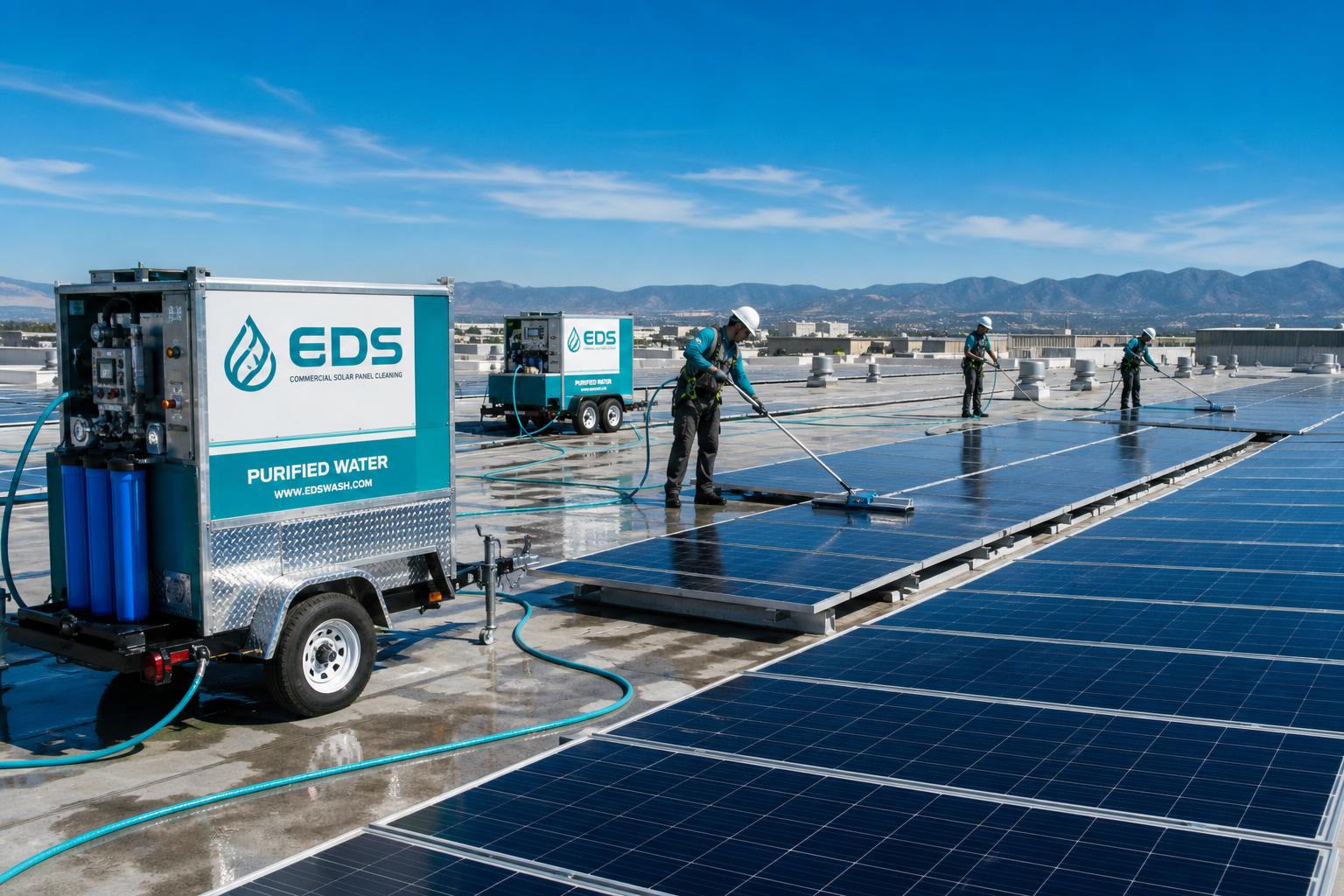
Warehouse rooftop solar in the Inland Empire soils differently from solar anywhere else in California, because the dominant contaminant is not agricultural dust but diesel particulate and construction dust from one of the densest freight corridors in North America. Riverside and San Bernardino counties carry an enormous concentration of distribution-center rooftop solar, sitting directly above and alongside constant heavy truck traffic. Every Detail Solar cleans and maintains those arrays.
The Inland Empire soiling problem is a freight problem
The Inland Empire became the logistics hub of the western United States, and the roofs of those distribution centers became some of the largest commercial solar installations in the state. That creates a soiling profile you do not see in the Central Valley:
- Diesel particulate. Heavy truck traffic along the Interstate 10, Interstate 15, and State Route 60 corridors puts fine combustion particulate into the air continuously. Unlike agricultural dust, it is oily. It bonds to glass and does not shed in wind.
- Construction dust. The region is still building. Active grading and construction next to an operating warehouse will load the neighboring roof for months.
- Santa Ana wind events. Offshore wind events push desert dust west through the passes and deposit it across the basin in concentrated bursts.
- Long dry season. Like most of Southern California, there is no meaningful natural rinse for most of the year.
The oily, bonded character of diesel particulate matters operationally. It is the kind of soiling that looks mild from the ground and does not come off with a rinse. It needs an actual wash.
Why warehouse rooftop arrays get neglected
Distribution-center solar is often owned or managed at a distance. The roof belongs to an asset manager or a REIT, the solar may be under a third-party ownership or lease arrangement, and nobody walks it. Arrays that nobody looks at do not get cleaned, and the production loss shows up as a slightly disappointing line on a report rather than as a problem anyone owns.
The scale makes it expensive to ignore. These are large arrays. A percentage point of production on a warehouse roof in Fontana or Moreno Valley is not a rounding error. Our answer page on how much production dirty panels lose covers how to measure it.
Working safely on large warehouse roofs
Large commercial roofs bring real constraints and we work to them:
- Roof warranty protection. We work in a way that protects the roofing membrane and the roof warranty.
- Fall protection and roof access protocols on every site.
- Coordination with facility operations so washing does not interfere with dock activity or tenant operations.
- Purified water washing so nothing dries onto the glass as a mineral film.
- General liability and workers compensation coverage, with a certificate of insurance available on request.
See our commercial rooftop solar cleaning and rooftop solar panel cleaning services pages for the full on-site process. Parking-lot and carport and canopy arrays at the same properties can be scheduled on the same visit.
Inland Empire areas we serve
Riverside, Moreno Valley, Corona, Jurupa Valley, Perris, Menifee, Temecula, Murrieta, Eastvale, Norco, Beaumont and Banning in Riverside County. San Bernardino, Fontana, Rancho Cucamonga, Ontario, Chino, Chino Hills, Rialto, Colton, Redlands, Yucaipa, Victorville, Hesperia and Apple Valley in San Bernardino County.
Riverside and San Bernardino counties together form the Inland Empire, east of Los Angeles and Orange counties. San Bernardino County is the largest county by area in the contiguous United States.
Related: solar panel cleaning in California · Los Angeles County · Kern County · solar panel cleaning services · the commercial cleaning guide