
By Dan Piepho, CEO, Every Detail Solar · Updated July 2026
Commercial solar panel cleaning is the scheduled removal of dust, pollen, ash, bird droppings, and mineral scale from solar arrays to recover output lost to soiling. Whether it pays off is a math problem, not a slogan: cleaning is worth it when the value of recovered production beats the cost of the wash. This guide gives you the numbers to run that math for your own site - including the cases where you should not hire anyone at all.
Why solar panels soil (and why it depends on where you are)
Soiling is anything that sits between sunlight and the cell: airborne dust, agricultural particulates, vehicle and industrial soot, spring pollen, wildfire ash, bird droppings, and hard-water scale from irrigation overspray. The mix and the rate depend almost entirely on geography and season. A rooftop in humid, rainy country soils slowly and gets rinsed often. A ground-mount array beside a Central Valley almond orchard or in the Sonoran Desert soils fast and stays soiled through a long dry season.
This is why a single national "you're losing X percent" figure is misleading. The physics that drives your soiling loss is local, which is the entire reason we publish regional data instead of one headline number.
How much does soiling actually cost? (the sourced numbers)
Here is what the independent research says - not our marketing:
- The U.S. National Renewable Energy Laboratory (NREL) maps PV soiling at hundreds of U.S. locations and reports that soiling causes roughly 3 to 5 percent of annual energy loss on average, expressed as an insolation-weighted soiling ratio.
- In arid and dusty regions, losses run well above that average. Peer-reviewed field studies have measured soiling power loss exceeding 1 percent per day during accumulation, with a single dust storm cutting output around 20 percent short-term.
- NREL research also found that rain alone did not restore performance after pollen soiling - a residue stayed on the glass until it was washed.
Our own field measurements are consistent with this range and break it down by mount type, region, and season. Every soiling number we publish traces to a named source like NREL. If we can't source it, we don't print it.
Cleaning methods, honestly compared
| Method | Best for | Trade-offs |
|---|---|---|
| Deionized (pure-water) pole system | Rooftops, edges, complex layouts, spot-free finish | Labor-paced; needs water handling on site |
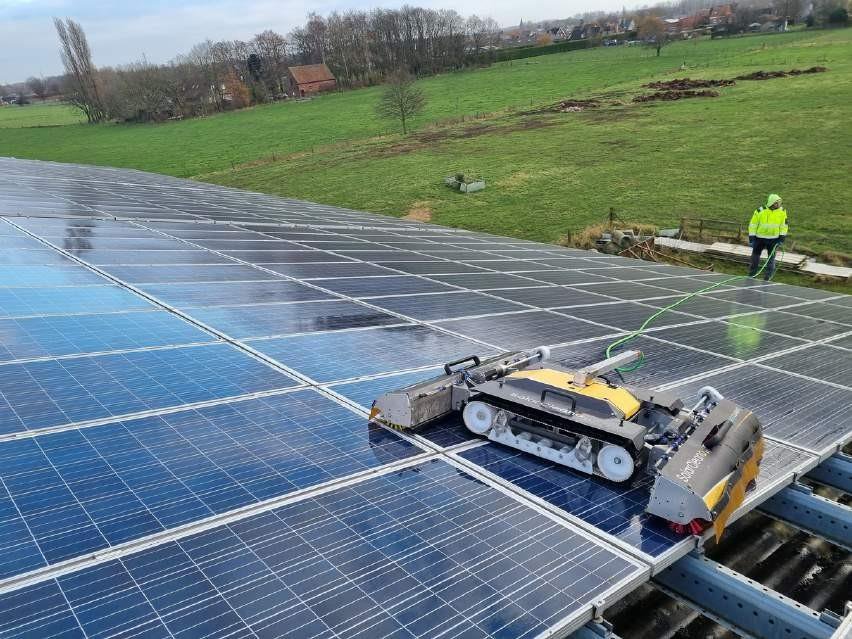
| Robotic cleaners | Long, uniform utility-scale rows at scale | Poor fit for irregular geometry and obstructions |
| Soft-brush + microfiber agitation | Cemented dust, lichen, bird droppings | Hands-on; slower per panel |
| Rain (do nothing) | Low-soiling, high-rainfall climates | Leaves residue; useless on droppings/scale/ash |
We use deionized water because it dries without leaving the mineral spots that ordinary hose water (often 300 to 1,800 ppm dissolved solids) leaves behind. But the honest point is that no single method wins everywhere. The right approach is matched to your mount type - which is why our utility-scale, rooftop, carport, and ground-mount programs each run differently.
How often should you clean? (frequency by environment)
- Low-soiling, high-rainfall regions: often annual, sometimes not at all. Let the rain work.
- Suburban / mixed commercial: typically once or twice a year.
- Agricultural, industrial, or highway-adjacent: quarterly is common; harvest and tillage seasons spike soiling.
- Desert and wildfire-exposed: quarterly or event-driven (after a dust storm or ash-fall).
Set the interval from measured soiling, not habit. The right frequency is the one where the next wash still recovers more than it costs.
When cleaning is NOT worth it
Most solar cleaning companies will never tell you this, so we will: if your site is in a cool, high-rainfall region with genuinely low soiling, professional cleaning may not pay for itself. If rain is already keeping your soiling ratio near 0.99 and there is no droppings, scale, or ash problem, a paid wash can cost more than the output it recovers. In those cases we will tell you to skip it, or to monitor and wash only when a specific event (ash-fall, a dust storm, a bird-roosting problem) changes the math.
We would rather lose a low-value wash than sell you a schedule you don't need. That is also the fastest way to earn a multi-site operator's trust on the sites that do need us.
How to hire a commercial solar cleaner (checklist)
- Ask for a pre-wash baseline and post-wash production comparison - not just before/after photos.
- Confirm deionized/pure-water process and manufacturer-compliant brushes so you don't void warranties.
- Get the crew model and schedule in writing so you can predict downtime.
- Ask how they price - a transparent, published methodology beats a mystery quote (see how we price).
- Ask for references in your region or climate, since soiling behavior is local.
If you want the site-specific version of this math, we run it for free. Send your panel count, mount type, and location and we will estimate your recoverable output before you commit to anything.